



Carlo Fenaroli, CEO of a 600-Person Social Enterprise Group, on Why TicNote Changed How He Leads

Carlo Fenaroli, CEO, social enterprise group, Italy
Carlo Fenaroli manages a lot of meetings — and it's not optional.
As CEO of a group of social enterprises operating in mental health services, with around 600 employees across the group, Carlo's daily work is fundamentally conversational. Meetings, appointments, video calls, training sessions, conferences: these aren't interruptions to his work. They are his work. The decisions made in those rooms, the nuances expressed by colleagues, the follow-up commitments made in passing — these are the raw material of organizational management.
"Meetings, appointments, video calls, training — these are all tasks I carry out daily and where I use TicNote," he says.
The challenge was a structural one. Carlo doesn't just attend these meetings. He leads them. He sets the agenda, guides the discussion, synthesizes perspectives, and leaves the room responsible for what happens next. Doing all of that while simultaneously producing an accurate record is, practically speaking, not possible.
The conductor's dilemma
There's a specific tension in Carlo's role that most note-taking tools don't address: the person who most needs an accurate record of a meeting is often the person least able to take one.
"The need for concentration and transcription clash with my role as the conductor of the work," he says. "I cannot rely on other colleagues' notes because they don't have my point of view."
That last part is crucial. A record taken by an attendee is accurate from that attendee's perspective. But the CEO's perspective — the one that integrates all the threads, that reads the subtext, that understands what the strategic implications of a particular exchange actually are — can only be documented by the CEO. And if the CEO is taking notes, they're not leading the meeting.
TicNote resolved this tension directly. He learned about it through YouTube, and adopted it for precisely this reason: to be fully present as a leader while ensuring that nothing of substance was lost.
The 18-person coordination meeting
Carlo points to a specific meeting as the moment that made the value concrete.
"A recent coordination meeting with 18 colleagues and many items on the agenda," he says. "Keeping track and producing such a complete report, also for follow-up, would have been very very difficult without TicNote."
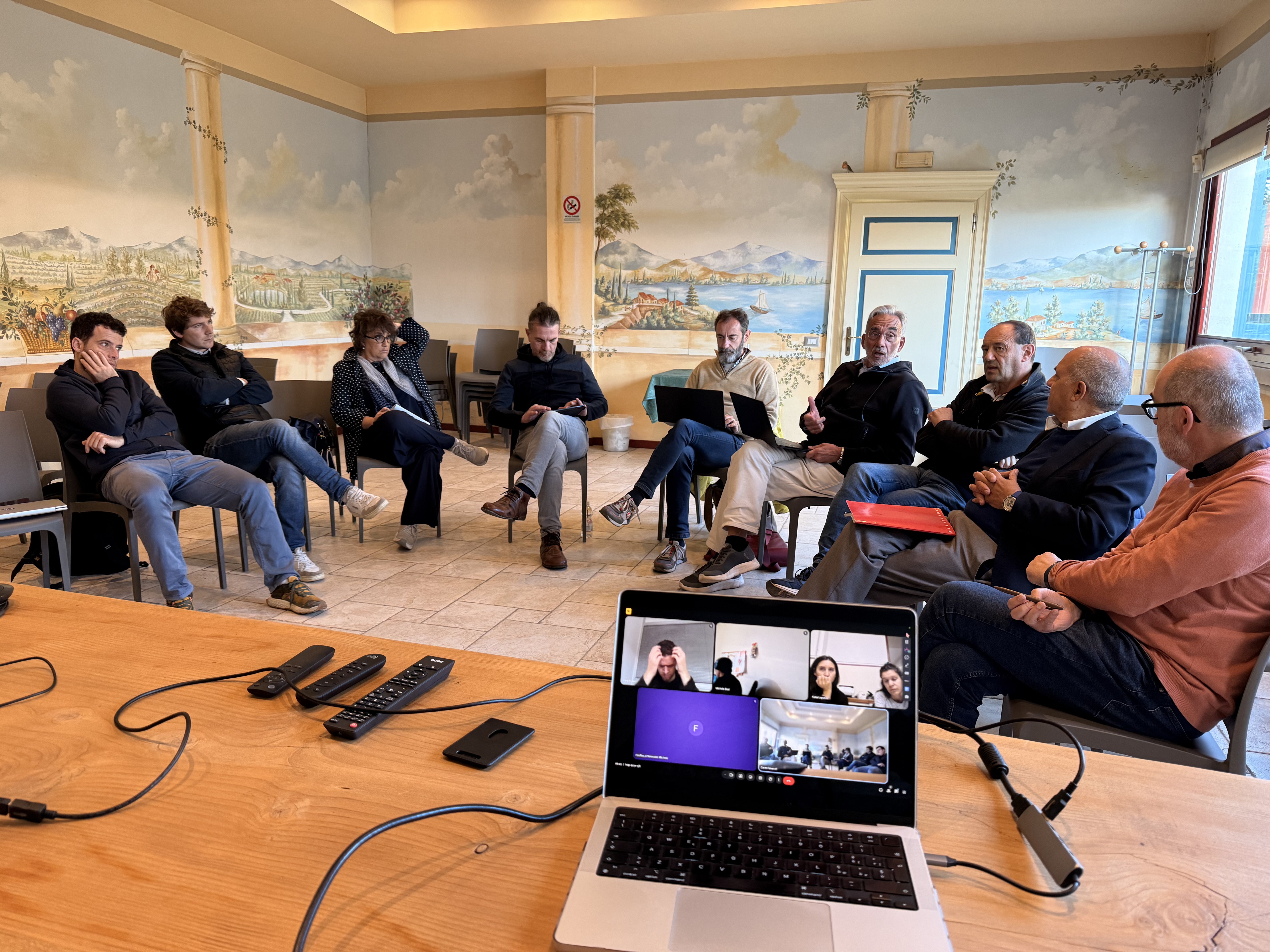
The kind of multi-stakeholder coordination meeting Carlo leads — in-person and remote participants, multiple agenda items, one complete TicNote record
A meeting of that size and complexity — multiple agenda items, multiple voices, decisions made at different points in the discussion — is exactly the kind of event where documentation typically fails. Notes become partial. Memory becomes selective. The follow-up process becomes a round of messages asking "what did we actually decide?"
Instead, Carlo had a complete record. One he could review at his own pace, structure into a report, and use to drive the follow-up actions that the meeting had generated.
"It helps me deepen and better understand the topics and subjects of meetings and focuses on the important points to develop," he says.
All the features — and meaning it
When asked which features he finds most valuable, Carlo's answer is unusually generous: "All the features are very very useful and interesting!"
That kind of response sometimes reads as deflection. In Carlo's case, it reads as accurate. His use case — leading dense, multi-agenda meetings across a large organization — touches almost every capability TicNote offers. Transcription for the raw record. Summary for the report. The ability to surface key decisions and action points across a long and complex conversation.
He uses it across all his meetings, training sessions, and conferences. The scope of his use reflects the scope of his need: a tool that keeps pace with an organizational leader's day.
"Yes," he says, when asked whether colleagues should use it too. "Others should also be using it."
