



Christian Langwieser, Quality Management Consultant, on Capturing What Matters Without Breaking the Flow

Christian Langwieser, quality management and process optimization consultant
Christian Langwieser's clients don't always know where their real problems are.
That's what makes his work interesting — and demanding. As the owner of a small engineering and consulting firm focused on quality management and process optimization for industrial SMEs, Christian spends his days working inside other people's organizations: conducting audits, analyzing processes, identifying the gap between how things are supposed to work and how they actually do. His toolkit is Microsoft 365 and SharePoint. His output is documentation, compliance, and clarity — often for clients navigating ISO 9001 requirements or regulatory obligations they don't fully understand.
"Many challenges revolve around outdated processes, missing documentation, or helping clients understand where their real problems lie," he says.
The work is precise. And it depends, more than almost anything else, on not missing what's said in a room.
When information moves faster than a pen
In a fast-paced audit or client interview, important information doesn't wait for you to finish writing the last sentence.
Christian knew this well. A client would be describing a process, or a problem, and mid-explanation, something critical would surface — a detail that only made sense in context, a connection that explained everything. If he was writing, he was half-listening. If he was listening, the detail was gone.
"Important points often came up while I was asking questions or observing processes," he says. "Manual note-taking sometimes led to gaps or missing context."
That missing context wasn't just an inconvenience. In quality management consulting, gaps in documentation can have real consequences — for compliance, for audit reports, for the recommendations he delivers to clients who are trusting him to get it right.
He came across TicNote in a YouTube review about AI-assisted note-taking tools. The premise matched exactly what he needed: a device that could capture conversations reliably, without requiring him to divide his attention between listening and writing.
"I wanted to try a device that could capture conversations reliably without distracting me during meetings," he says.
Staying in the conversation
The change in how Christian works during client engagements is simple to describe: he stopped splitting himself.
"I use TicNote during client meetings, audits, and interviews to capture the conversation without interrupting the flow," he says. "Afterwards, I turn the recordings into structured summaries or action lists that I can integrate into my quality management work."
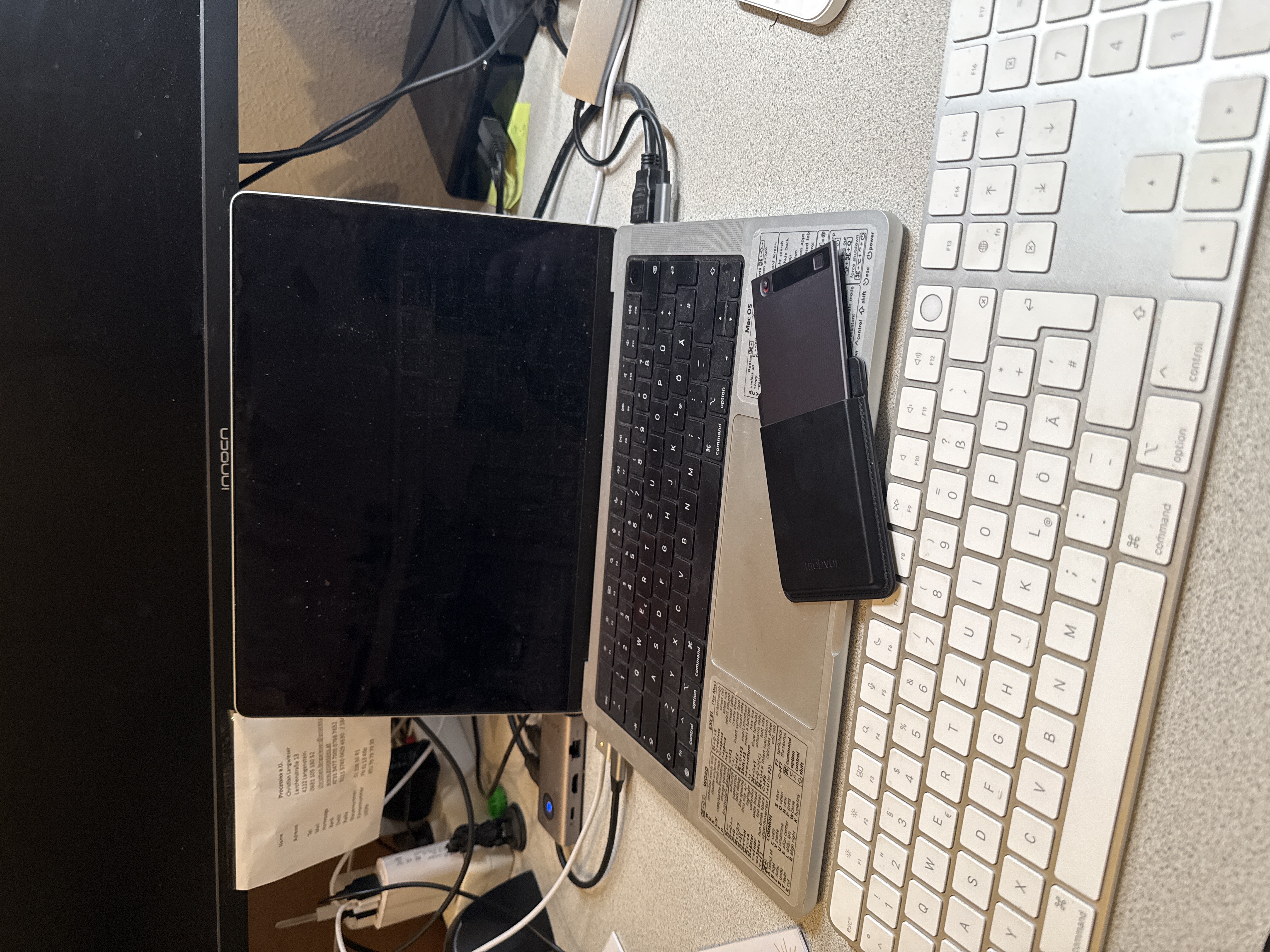
Christian's workstation — where audit transcripts get turned into structured compliance reports
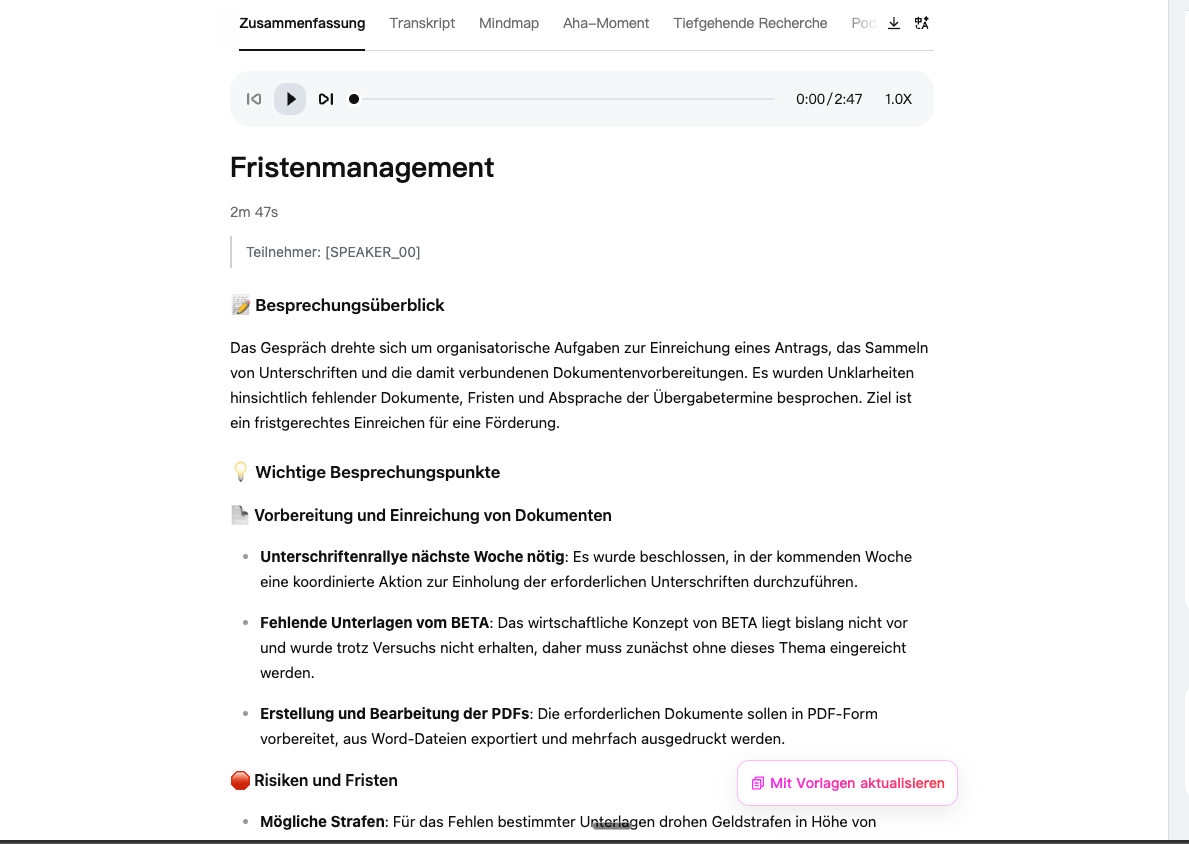
A TicNote session from Christian's consulting work — summary and mind map ready for integration into audit documentation
The transcription and summarization features do the heavy lifting. A two-hour audit debrief becomes a structured set of findings. An interview becomes a documented account with clear attribution. A client meeting becomes action items Christian can deliver the same day.
"They turn long meetings or interviews into clear, structured notes that I can directly use for audits, reports, and client documentation," he says.
For consulting work, where the deliverable is often exactly that — a report, a set of recommendations, a documented process — the compression from raw conversation to finished output is the real value.
The audit that happened too fast
Christian remembers one internal audit clearly. Not because it was unusual — but because of how different the aftermath was.
"A lot of important information came very quickly," he says. "TicNote recorded everything so I didn't have to pause the discussion to take notes. Later, the transcript helped me create a clean audit report in a fraction of the usual time."
In audits, pausing the discussion to write something down changes the dynamic. It signals to the person being interviewed that something has flagged their attention. It breaks the rhythm of a conversation that's generating real information. Christian didn't have to do that. He let the audit run at its own pace, stayed in the room with the people he was talking to, and came back to the details afterward.
"That was a real 'Wow, this makes my life easier' moment," he says.
Confidence, not just efficiency
The shift isn't just in efficiency. It's in confidence.
"I can stay fully focused on the conversation instead of worrying about missing details," he says. "It gives me more confidence, especially in audits or interviews where every statement matters."
In quality management consulting, every statement does matter. Compliance documentation, audit trails, process descriptions — these are records that clients rely on, and that may eventually be reviewed by regulatory bodies. The accuracy isn't optional.
TicNote doesn't replace Christian's expertise or judgment. What it does is make sure that expertise is applied to complete information — not a reconstructed version of what he thinks he heard.
"Yes, absolutely," he says of TicNote's value for others in consulting and quality management. "TicNote helps capture every detail without interrupting the flow. That makes documentation easier and reduces the risk of missing important information."
Christian Langwieser is the owner of a quality management and process optimization consultancy, working with industrial SMEs. He uses TicNote in client audits, interviews, and meetings to ensure complete documentation without interrupting the work.
