



Clinton Reid, Account Director, on How Speaker Identification Changed What Meeting Notes Can Actually Do
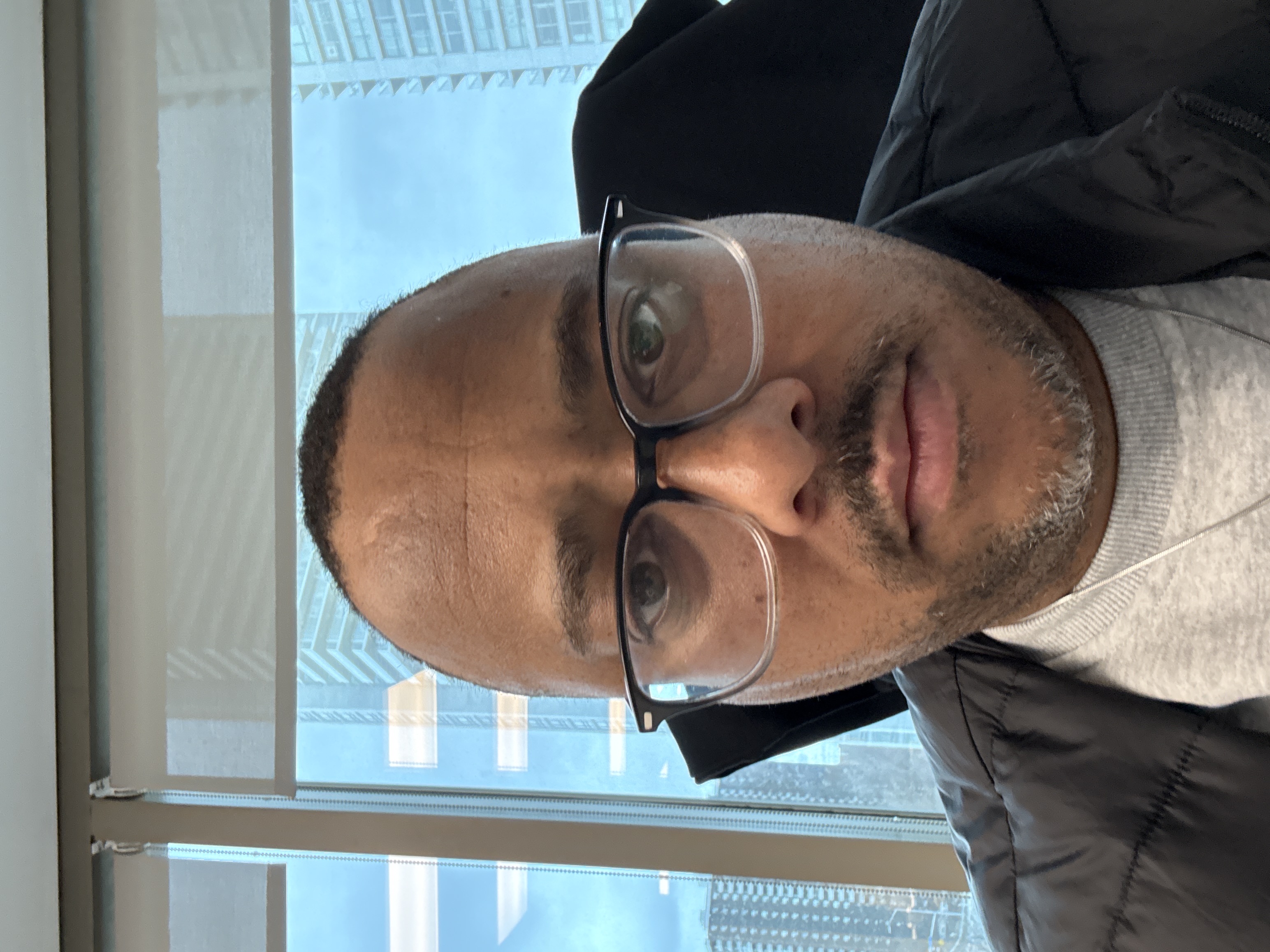
Clinton Reid, Account Director, digital transformation consultancy
Clinton Reid starts recording before he even pulls out of the driveway.
As an Account Director managing a digital transformation consultancy, his day is a continuous sequence of calls, transitions, and handoffs — morning calls on the drive in, phone conversations in the parking lot, Teams meetings at the desk, Zoom sessions with clients in the afternoon, facilitated workshops when he travels. The medium changes constantly. The need to capture and act on what's said never does.
For years, documentation was the weak link. His team used ClickUp for project management. But getting what was said in a conversation to reliably become an assigned task — attributed to the right person, with the right context — was harder than it looked.
"Documentation: really pushing the teams to do proper minutes, and translating those tasks into ClickUp for follow-up — that has been the challenge," he says.
Paper notes don't know who said what. Voice notes transcribe words but not speakers. And platforms like Teams and Google Meet have their own recording restrictions and access controls that made consistent documentation even more difficult. He needed something that moved with him — and that could tell him not just what was said, but who said it.
The speaker identification problem nobody talks about
In a meeting with a dozen people from different departments — dev, QA, ops, account management — the value of a transcript depends heavily on knowing which voice belongs to which role.
"You can write it down," Clinton says, "but being able to understand exactly who spoke and said what based on the transcript — the paper notes really didn't know who said that comment, that decision, that thought."
When a decision is made in a meeting, what matters isn't just that it was made — it's which side of the table it came from, what the reasoning was, and who owns the follow-up. Without that attribution, the transcript is noise.
Clinton found TicNote while searching for a way to record phone calls that weren't on speaker — calls through his earpiece while walking. He saw the connection to ChatGPT and Gemini, the mind mapping features, and the speaker identification capability. That combination was what brought him in.
How he actually uses it
TicNote lives clipped to Clinton's phone from the moment he leaves the house.
In the car, if he's on a speaker call, it records through the car's audio. When he transitions out and takes a call through his ear, he switches to phone mode. At the office, it clips to the back of his MacBook — two seconds to activate, recording every call. In meetings, it goes on the desk. When he's facilitating a session, he carries it with him around the room.
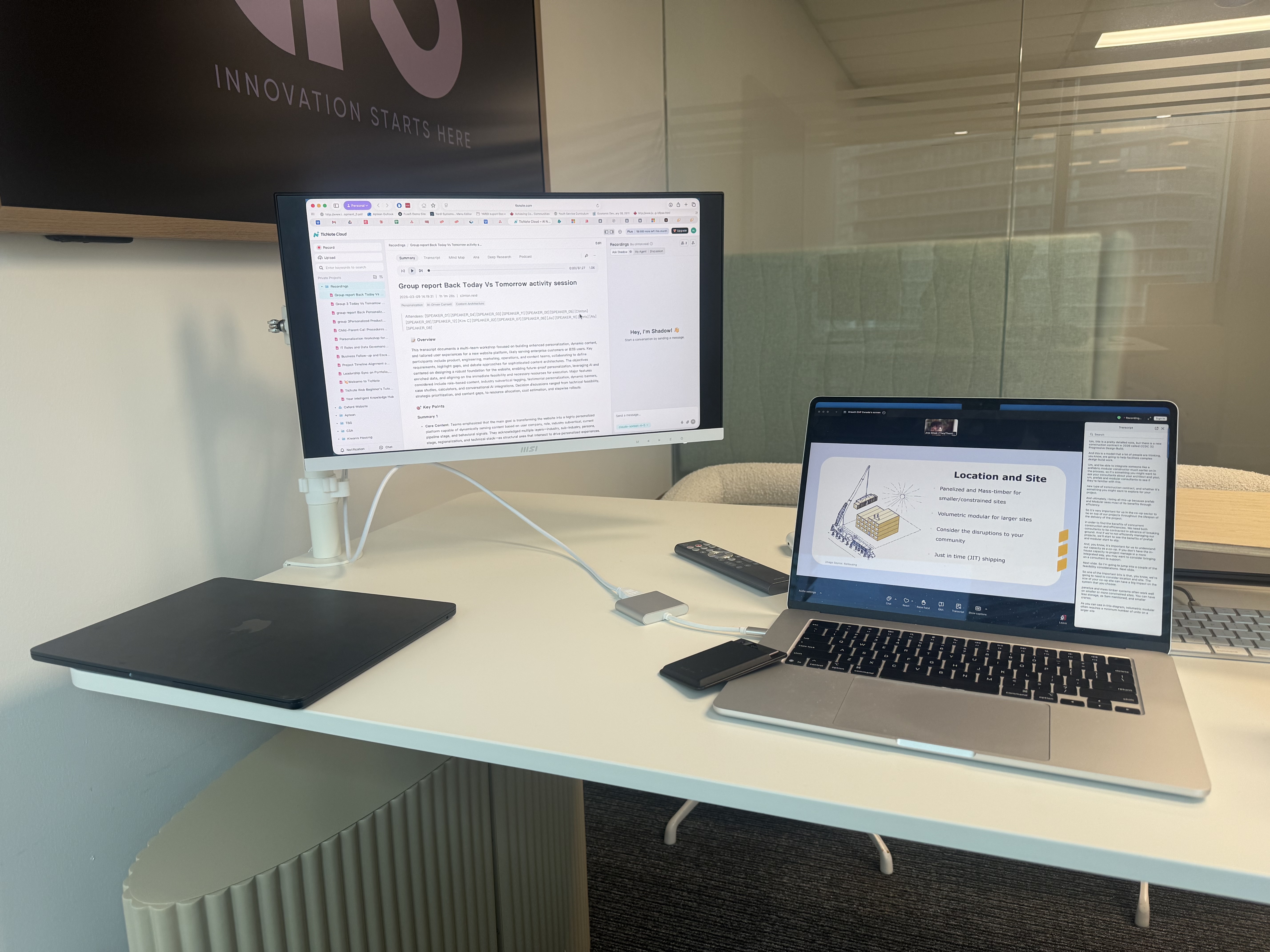
Clinton's office setup — dual screens, active presentations, and TicNote clipped to the MacBook capturing every call
"I was away for three days and was able to produce notes and capture some side conversations that occurred in breakout sessions," he says. "I was able to take it and just leave it in a breakout session, record those conversations, then click it off, move to another group that had a really dynamic conversation, and record that."
Thirteen people. Every voice labeled.
The moment that changed how Clinton thought about the device happened at a three-day offsite session.
"When I finally got the transcript, I sat there and just started listening to the voices," he says. "I was able to type in the different people in the room. Thirteen, maybe fourteen people. Able to identify the voices, label the names, label the department they came from."
The transcript became something different then. Not just a record of what was said — but a map of who said it, from which function, at which point in the conversation. The QA perspective. The dev perspective. The account side. Separated and identifiable.
"I can identify thirteen people in a transcript, re-label it, and it stores and remembers that person's voice," he says. "Amazing."
What changed downstream
Meeting notes are richer. Clients who receive summaries comment on the level of detail. Task attribution is cleaner. The speed from conversation to documented output has compressed dramatically.
"It's changed the way that I collaborate, because it's giving me a richer understanding of conversations," he says. "Small things that I might have missed, I've been able to replay transcripts. I've listened to the voices and tones of people speaking — that has changed how I approach and contextualize those conversations."
Time efficiency. Clarification. Consistency. Three words he comes back to when describing what TicNote has added to his team's output.
"Marketing folks, account services, business development folks — those are really great individuals to be able to use something that you stick on your phone, just have it sitting there, and then just sort of recording those conversations," he says. "Everyone needs this."
